Kategoriat
Uncategorized

Cardone: Sell or Be Sold

⛔️ En voi suositella tätä kirjaa. Kirjailijan arvot eivät kohtaa omiani. Lopetin (henkisesti) kirjan lukemisen oheiseen kappaleeseen: ”TIPS FOR HAVING A GREAT ATTITUDE: Avoid newspapers, television, and radio.” Ei näin. Sanomalehdet, televisio eikä radio pilaa kenekään asennetta. Päinvastoin. Mutta kirjan kirjoittajien kaltaiset ihmiset neuvoineen pilaavat asenteen.


✅ Tämä on ”innostunut toisto”-tyyppinen kirja. Kirjan sivuilla ulkoilutetaan paljon erilaisia myyntityön konsepteja. Toiseksi kirjailija on ilmeisesti pitkänlinjan myynnin ammattilainen ja siksi hän päätyykin kertomaan pääsääntöisesti omista kokemuksistaan. Vaihtoehto vailla vertaa.


✅ Kirjan perusoppimäärä koostuu seuraavista ajatuksista: Hinta ei ole este, asiakkaiden tapaaminen on kaupanteon alku, myy sitä mitä asiakas tarvitsee, kuuntele ja saat (vasta)tarjouksen, anna asiakkaan päättää, kuuntele mitä asiakas sanoo ja ryhdy myymään sitä, kysy lopussa oliko tästä hyötyä…

⛔️ Jos on pakko, niin lue tämä kirja kun olet vasta aloittelemassa myyjän kunniakasta karriääriä tai uskosi myyntityöhön horjuu. Hyvä kirja siis lujittamaan myyjän uskomuksiin ikiaikaisista innostuksen lähteistä.

Kategoriat
Uncategorized

Aimo Autio: Markkinoinnin perusteet (1971)

Kirjasta

Tiesitkö, että Suomessa käytettiin mainontaan 2,0 % BKT:sta kun vastaava luku oli Ruotsissa 1,6 % vuonna 1967? Yllättävää, että käytimme enemmän rahaa kuin ruotsalaiset.

Minkälainen kirja oli?

Aimo Aution ”Markkinoinnin perusteet” on pittoreski kirja menneisyydestä. Oiva kirja, joka sukeltaa suomalaisen markkinointiajattelun kehittymiseen 1960-luvulla. Varmaan se on ollut aikanaan erittäin tarpeellinen perusteos, koska kirjassa opetetaan myyntibonusmallien rakentamisesta kateprosentin laskemiseen.

Toki kirja on 50 vuotta vanha ja seuraavilla suorat lainaukset ajattelun muutos paljastuu melko nopeasti:

–      ”Monissa yrityksissä tarvitaan varsin vähän varsinaista myyntitoimintaa”,

–      ”Myynnillä tarkoitetaan persoonallista tai epäpersoonallista toimintaa, jonka tarkoituksena on auttaa ja/tai taivuttaa mahdollinen asiakas ostamaan tavara”

–      ”Mainonta on tällöin myynnin alakäsite”.

Semminkin, että asiakaskokemus on noussut keskiöön, niin harvoin enää pyritään taivuttamaan ketään. Tai yrityksissä vallitsee henki, että kaikkien olisi hyvä osata myydä tai palvella asiakasta. Tai että mainonta olisi myynnin alakäsite. 

Mitkä ovat kirjan keskeiset ideat? 

”Markkinointi on kaupallisten toimintojen suorittamista”. Kirjassa on paljon perusteellista selitystä markkinoinnin ja myynnin suhteesta, joista poimin esimerkkejä. Autio lanseeraa mm. yhteenniveltäminen-käsitteen, jolla tarkoitetaan tarvetta saattaa valmistus-, osto-, myynti- ja kuljetustehtävät yhteiseen käsitykseen tavoitteista.

Yhteistyön halua ja henkeä toivotaan kasvatettavan mm. pari kertaa vuodessa järjestettävien myyntimiesten päivien kautta. Kirja henkii kaikkea sitä mitä tänäänkin yrityksissä tavoitellaan. Mm. kenttämyyjän valmennus nähtiin tärkeäksi osaksi hyvää työhön perehdytystä ja siksi uusi tulokas haluttiin laittaa vanhan ja hyvän valmentajan myyjän matkaan. Tai myyntiosaston organisointi perustuu Aution mukaan kolmeen periaatteeseen:

1)   Tavaralajien mukaan.

2)   Asiakasryhmien mukaan.

3)   Maantieteellisten alueiden mukaan.

Todennäköisesti tämän päivän social selling- tai henkilö brändäys-ohjeet saattavat 50 vuoden päästä olla vanhanaikaisia. Mutta perusperiaatteet eivät ole muuttuneet.

Mitä meidän pitäisi tehdä kirjan perusteella?

Nostaa selvästi asetetut myyntitavoitteet kunniaan ja neuvotella myyjät noudattamaan niitä

Mitä minun pitäisi itse tehdä? 

Hankkia Erva-Latvala Oy:n ”Myyntijohtajan käsikartasto”.

Yhteenveto

Kirja kuudella sanalla –  “Valvonnan kohteille on etukäteen esitettävä vaatimukset ja saatava niille heidän hyväksymisensä”.

Kategoriat
Uncategorized

Paul Smith: Lead with a Story

About the book

Why should you read about storytelling?

“First, it extends the usefulness of storytelling to a much wider range of leadership challenges”

“Second, it offers more thorough and practical advice for how to craft your own stories for any leadership challenge. That starts with a simple structure for a good business story. But it also includes advice on six other key elements you’ll need to turn that good story into a great one:

–      Metaphors,

–      emotion,

–      realism,

–      surprise,

–      style,

–      and how to put your audience into your story.

What are the key learnings?

Many great companies have a high-level “corporate storyteller”. For example:

–      “At Nike, all the senior executives are designated “corporate storytellers.”

–      “3M banned bullet points years ago and replaced them with a process of writing “strategic narratives.”

Why tell stories?

1.   “Storytelling is simple.

a.   Anyone can do it. You don’t need a degree in English, or even an MBA. 

2.   Storytelling is timeless.

a.   Unlike fads in other areas of management such as total quality management, reengineering, Six Sigma, or 5S, storytelling has always worked for leadership, and it always will. 

3.   Stories are demographic-proof.

a.   Everybody—regardless of age, race, or gender—likes to listen to stories. 

4.   Stories are contagious.

a.   They can spread like wildfire without any additional effort on the part of the storyteller. 

5.   Stories are easier to remember.

a.   According to psychologist Jerome Bruner, facts are 20 times more likely to be remembered if they are part of a story. 5 Organizational psychologist Peg Neuhauser found similar results in her work with corporations. She found that learning derived from a well-told story is remembered more accurately, and for far longer than the learning derived from facts or figures. 

6.   Stories inspire.

a.   Slides don’t. Have you ever heard someone say, “Wow! You’ll never believe the PowerPoint presentation I just saw!” Probably not. But you have heard people say that about stories. 

7.   Stories appeal to all types of learners.

a.   In any group, roughly 40 percent will be predominantly visual learners who learn best from videos, diagrams, or illustrations. Another 40 percent will be auditory, learning best through lectures and discussions. The remaining 20 percent are kinesthetic learners, who learn best by doing, experiencing, or feeling. Storytelling has aspects that work for all three types. Visual learners appreciate the mental pictures storytelling evokes. Auditory learners focus on the words and the storyteller’s voice. Kinesthetic learners remember the emotional connections and feelings from the story.

8.   Stories fit better where most of the learning happens in the workplace.

a.   According to communications expert Evelyn Clark, “Up to 70 percent of the new skills, information and competence in the workplace is acquired through informal learning” such as what happens in team settings, mentoring, and peer-to-peer communication. And the bedrock of informal learning is storytelling. 

9.   Stories put the listener in a mental learning mode.

a.   Listeners who are in a critical or evaluative mode are more likely to reject what’s being said. According to training coach and bestselling author Margaret Parkin, storytelling “re-creates in us that emotional state of curiosity which is ever present in children, but which as adults we tend to lose. Once in this childlike state, we tend to be more receptive and interested in the information we are given.” Or as author and organizational narrative expert David Hutchens points out, storytelling puts listeners in a different orientation. They put their pens and pencils down, open up their posture, and just listen. 

10. Telling stories shows respect for the audience.”

 Story structure is how: 

–      “You should see your story in your mind’s eye before you create it (Envision).

–      Realism and appropriate writing style should be pervasive throughout your entire story (Environment). 

–      Emotion and surprise punctuate your stories with excitement and interest (Energize). 

–      Metaphors are the most efficient literary device to teach lessons in stories (Educate). 

–      And recasting your audience into your stories, instead of just telling them stories, takes the power of storytelling to a completely new level (Empower).”

Power of metaphor at its finest—to make your recommendations as compelling as possible. For example about a taxi ride:

–      “Waiting for that moment is a bit like trying to hail a cab in New York. You might have to wait a while. So when a yellow cab does pull over to pick you up, you’d better get in. You might not get another chance for a long time.

–      Challenge a fundamental assumption your audience has. Most recommendations start with a shared set of preconceived notions and build from there to a conclusion. But there’s little you can do to make a bigger impact on your audience than to show them those assumptions are false.”

How to structure of a story?

“IF YOU ASK A 10-YEAR-OLD, “What’s the structure of a good story?” the child might say something like, “Oh, that’s easy! There’s a beginning, a middle, and an end.” True, perhaps. But not very helpful.” 

“If you ask a Hollywood script writer the same question, she might tell you there are six parts: the setup, catalyst, first turning point, climax, final confrontation, and resolution. True again. And if you plan to write a screenplay or a murder mystery, that structure will serve you well.” 

“If you ask a cognitive psychologist, he will likely give you an even more complicated answer. For example: setting, main characters, conflict and resolution, initiating event, internal response, attempt, consequence, reaction, and conclusion.” 

CAR = Context, Action, Result.

“Context

1. Where and when?

2. Who is the main character?

3. What does the character want?

4. Who or what is getting in the way?”

“Action”

This is where you tell what happened to your main character.

Result 

“The result is the final stage of the story where you accomplish three main things. In addition to telling how the story ends, this is where you explain the right lesson the audience should have learned, and link back to why you told the story in the first place.”

AN example of a great story

“IT’S WELL ESTABLISHED in the marketing world that if you design your product or service for everyone, what you end up doing is designing for no one. You create a mass of compromises that fails to please anyone. Therefore, the theory holds, you should pick a subset of your customer base to design your offerings around.

If you choose well, you’ll have a group small enough that its needs are easy to identify and understand, but that represents the lion’s share of your growth potential. Called segmentation in industry speak, that’s the position P& G has taken with its own brands, and the advice it gives its retail partners about how to delight their shoppers as well.

Research shows that 20 to 30 percent of shoppers in any given store are responsible for 70 to 80 percent of all the purchases.

Consumer research manager Monika Jambrovic removed the vague and amorphous title “high potential shopper” and replaced it with the name and photograph of one woman—Lisa. She took something abstract and made it concrete.

It was a huge success! The retailer’s management immediately took to the idea and began using Lisa as their primary design target.”

Describing your idea in specific, concrete terms is almost always more effective, for two reasons.

–      First, it helps people understand your idea more easily.

–      Second, concreteness helps people apply your idea to their situation.

“My country didn’t send me 5,000 miles to start this race. They sent me 5,000 miles to finish it.”

Great beginnings:

–      “The first is the element of surprise.

–      The second method is to create a mystery.

–      The third method is the most powerful one of all, and also the simplest. You’ve seen many examples of it in this book already. The best way to get the attention of a business audience is to quickly introduce a main character they can relate to, and put the character in a challenging situation or predicament.”

“Good spoken language” -tactics:

1.   “Shorter sentences.

2.   Smaller words. For some reason we are less tempted to throw in impressive-sounding words when speaking than we are when writing.

3.   Active voice.

4.   Getting to the verb quickly.”

A HINT:

–      “Microsoft Word can calculate your Flesch-Kincaid Grade Level automatically. (In Spelling and Grammar check options, select “Check grammar with spelling” and “Show readability statistics.” After you run the Spelling and Grammar check, a window will pop up with the readability report.”

–      Effective Writing for Army Leaders, it defines a writing “clarity index” as follows. Calculate the average number of words per sentence. The target should be around 15. Then calculate the percentage of words that are three or more syllables. The target should be 15 percent. Add those two numbers together for the clarity index. Ideal is around 30. Below 20, and the army considers the writing too abrupt. Over 40 it considers difficult to understand.

–      French writer and poet Antoine de Saint-Exupéry once observed, “A designer knows he has achieved perfection not when there is nothing left to add, but when there is nothing left to take away.”

–      Storytelling shouldn’t take a long time. Most of the stories in this book can be told verbally in two to four minutes. Some take less than one minute. As a rule of thumb, a comfortable speaking pace is about 150 to 180 words per minute. So a 500-word story will take about three minutes to tell.

–      The last literary device worth mentioning is repetition, which can greatly enhance the effectiveness of a story.

 “You may have to fight a battle more than once to win it.” —MARGARET THATCHER, former Prime Minister of England

“Five key lessons the company learned from the experience. In hindsight, the first three shouldn’t be too surprising: 

(1) know what your consumer wants, 

(2) develop a product and marketing messages to meet those expectations, and 

(3) organize a strong team to deliver results. 

(4) The fourth lesson was a little more interesting: Set realistic goals. They adopted a five-year plan, not a one-year plan. They realized the magnitude of the changes they needed to make were too ambitious to accomplish in a matter of months. Despite that, they succeeded two years ahead of schedule.

(5) The final lesson Mike explained, however, is the most telling of all, and the key point I want to make. He summarized it in two simple words: “Don’t stop.” Don’t give up too soon.”

“Empathy is so potent because almost every business decision affects other people and how they think and feel.”

“Many of life’s failures are people who didn’t realize how close they were to success when they gave up.” (Thomas Edison)

“A true leader always keeps an element of surprise up his sleeve, which others cannot grasp but which keeps his public excited and breathless.” —CHARLES DE GAULLE, former French president.

“Learning is not compulsory. But neither is survival.” —J. EDWARDS

“Feedback is the breakfast of champions.” —KENNETH BLANCHARD

“We cannot solve our problems with the same thinking we used when we created them.” —ALBERT EINSTEIN

“If a picture is worth a thousand words, then a metaphor is worth a thousand pictures.” —GEORGE LAKOFF AND MARK JOHNSON, Metaphors We Live By

“Never tell people how to do things. Tell them what to do and they will surprise you with their ingenuity.” —GENERAL GEORGE S. PATTON JR.

“If people aren’t laughing at your ideas, you aren’t being creative enough.” —DAVID ARMSTRONG

Sales is everyone’s job 

“The real selling doesn’t start until the buyer says no.” —UNKNOWN

About sales presentations:

1.   “If your sales presentation is in the trash can, you’d better have a good story. And sales presentations have a way of ending up in the trash can. A story will stick with the buyer far longer.

2.   You should be able to explain every aspect of your business model in terms of the benefit it provides the customer. Even if it’s why you have to charge the price that you do, explain why that price benefits the customer, not why you need to charge that much. (“ Paying in this industry is a rip off.”)

3.   Training budget a little tight? Tap into the best source of advice on successful sales techniques in your company—the purchasing department. Share Bob Smith’s story of the new steel salesman with the heads of your sales and purchasing departments. Make arrangements for sellers and buyers to spend more time together. They both have much to learn from each other.

4.   At some point, just about everyone gets involved in a sales call, even if you’re not a salesperson. Before you send people out to the field for the first time, tell them the story of the unwelcome business card. They’ll be much less likely to make a similar mistake. And your sales team will thank you for it.”

“People are going to tell stories about you whether you want them to or not. Choose which ones they tell.” —BOB MCDONALD, CEO, Procter & Gamble

Getting started and barriers

Barrier 1: I don’t know where to find good stories

Stories from your past.

Stories you see happen around you.

Stories that other people tell you.

Ask them.

Hold a contest.

Hold storytelling sessions.

Conduct formal interviews.

Barrier 2: I have trouble remembering the stories when I need them. It’s time we start databasing our stories!

Barrier 3: I’m not sure where to tell my stories

Barrier 4: I don’t think stories belong in a formal memo or e-mail This is one of the most common misperceptions I hear.

 “I taught my dog to whistle!” “I can’t hear him whistling.” “I said I taught him. I didn’t say he learned it.” —1991 CARTOON

How should we change according to the book?

Two things we should do:

–      We should build a story collection.

–      Every story should be relevant, be in a right context and be entertaining

What should I personally do?

Read “Management by Storying Around” by David Armstrong, and “Corporate Legends & Lore” by Peg C. Neuhauser.

Summary

The book in six words – ““Tell me and I forget. Teach me and I remember. Involve me and I learn.” (Benjamin Franklin)

Kategoriat
Uncategorized

Chris Smith: The Conversion Code

About the book

The Conversion code book is something that you don’t see every day. The learnings of the book are valuable although the cases and evidence is mostly coming from experience of Chris Smith. “The Conversion Code is your guide to getting an ROI, ASAP. It’s a proven step-by-step blueprint to increasing leads and sales, immediately.” He shares a lot of his insights on sales and how he personally has used different tools.

What are the key learnings?

“Albert Mehrabian’s 7-38-55 Percent Rule and the science behind how humans communicate”:

–      55 % body language.

–      38 % tone of voice.

–      7 % words.

And if Mehrabian’s rule is for IRL (in-real-life) sales so Chris Smith’s rule of thumbs are for online sales.

Key learnings are:

–      Design is king, not content.

–      Landing Pages Are the New Black

–      “The more content I have created, the more cash I have collected. Period.”

–      Lead generation by adding “lead magnets”

–      Speed + Tenacity + Script = Highest Conversion Rate Possible

–      Emails That Work

Is content king or design?

“Participants discussed their first impressions of a website. There were two factors that led them to reject or mistrust a website quickly. The overwhelming majority of comments related to the design of the website.

Ninety-four percent cited design and only 6 percent cited content in relation to “the number of times a factor was mentioned as a percentage of the total number of comments about rejection.” So maybe content isn’t king after all.…

If you are going to capture and convert quality Internet leads, you need to gain their trust.”

So in a sense design is king.

Landing Pages Are the New Black

“They have only ONE purpose. In 2003, the IT department at Microsoft invented landing pages in response to poor online sales of their flagship business product, Office.

Keep in mind that even if you have no design or technical skill whatsoever, there are some very cool companies like LeadPages, Instapage, or Unbounce that let you build inexpensive (or free) landing pages in just a few easy clicks. Be sure to search their existing themes by keyword like “real estate” to find pre-built, industry-centric designs. Even SumoMe (which I mentioned earlier as a suite of great website plug-ins) built something called WelcomeMat, which is basically a landing page that sits on top of a blog post or the page of your website someone is on (pushing the content “below the fold”).”

“Here are the nine key elements Kissmetrics identified that make a perfect landing page (with my take on each):

1.   Headline: Make it clear, concise, and “coupled.”

2.   Subheadline: With the subheadline, we simply want to continue them down the path the headline started them on

3.   Description: Make sure you triple-check all grammar, punctuation, and spelling.

4.   Testimonial: The goal here is to establish trust quickly.

5.   Call to action: When the visitor is ready, your call to action must be obvious, easy to find, the right color, and contain the right copy.

6.   Clickable button(s): A conversion button should stand out and be near/ below the call to action, either accompanying the message or reiterating it word for word.

7.   Remove links

8.   Image or video

9.   Stay above the fold

Writing the Perfect Blog Post

The more content I have created, the more cash I have collected. Period. “The Anatomy of a Perfect Blog Post.”:

–      Headline

–      Storytelling Hook

–      Fewer Characters per Line at First

–      Featured Image

–      The 1,500 + Word Sweet Spot

”What is a lead magnet? Basically, it is something so valuable that someone would give up their name, phone number, and email address to access it.

Retargeting

Retargeter provides seven best practices for running retargeting campaigns:

1. Don’t overbear or underbear.

2. Make sure your ads are well branded.

3. Understand your view-through window.

4. Have an incredible network.

5. Optimize your conversion funnel.

6. Target an actionable audience.

7. Segment your active audience.

Speed + Tenacity + Script = Highest Conversion Rate Possible

In fact, you have a 100x better chance of turning a lead into a conversion in the first five minutes than you do after just 30 minutes.

The ideal time to call leads in order to convert them is between 8 and 10 a.m. and 4 and 6 p.m. Calling on Wednesday and Thursday gives you the best chance at reaching someone.

How should we change according to the book?

Not to write blogs that are longer than 2000 word.

What should I personally do?

Check FB Messenger!

Summary

The book in six words – “Albert Mehrabian’s 7-38-55 Percent Rule”

Kategoriat
Uncategorized

Fisher & Ury: Getting to YES

About the book

Getting to YES is a book about negotiating agreement without giving in. As Robert Fish and William Ury states in the book – negotiation is a fact of life. We are always making trade-offs, but the best part is that you get to choose what you want. It’s a back-and-forth communication designed to reach an agreement.

“Getting to YES”-method is about using independent standards to discuss the fairness of a proposal, getting to you what you deserve and protect you from getting taken.

What are the key learnings?

The key learning of the book is that the agreement is often based on disagreement and with principled negotiation you can reach a deal.

“Substantive issues need to be disentangled from relationship and process issues. The content of a possible agreement needs to be separated from questions how you talk about it and how deal with the other side. Each set of issues needs to be negotiated on its own merits:

–      Substantive issues

o  Terms

o  Conditions

o  Prices

o  Dates

o  Numbers liabilities

–      Relationship issues

o  Balance of emotions and reasons

o  Ease of communications

o  Degree of trust and reliability

o  Attitude of acceptance (or rejection)

o  Relative emphasis on persuasion (or coercion)

o  Degree of mutual understanding

There is no trade-off between pursuing a good outcome and pursuing a good relationship.”

The Principled Negotiation

Before you anything – start by “envisioning what a successful agreement might look like.”

In the principled negotiation the negotiator looks for mutual gains and when interests conflict, “the negotiator should insist that the result be based on some fair standards independent of the will of either side”.

The principled negotiation method is totally apart from hard and soft methods. In soft negotiation the negotiator wants to avoid personal conflict and in hard negotiation the negotiator” sees any situation as a contest of wills”.

The “Getting to YES” or principled method has four major parts:

1)   PEOPLE: Separate the people form the problem.

2)   INTERESTS: Focus on interests, not positions.

3)   OPTIONS: Invent options fort mutual gain.

4)   CRITERIA: Insist on using objective criteria.

When evaluating the end-result – agreement, you should consider is the agreement:

·     Wise agreement.

·     Efficient.

·     Improve relationships (or at least not damage).

People

Separate the people form the problem or “don’t bargain over positions” means that people should be attacking the problem, not each other. “Being nice is no answer” means that you are dealing with either hard or soft negotiation. When you take the soft position you loose your shirt. When you are driving a hard negotiation you are about to loose your face.

When building the people problem, you should remember three things – perception, emotion and communication:

–      In perception you should put yourself into their shoes. Ask their perception or advise and give them some credit/stake in the outcome.

–      In emotions pay attention to “core concerns”, make emotions legitimate and allow the other side to let off steam and use symbolic gestures (shake hands, eat together).

–      In communication remember to talk to each other (acknowledge what is being said – repeat what you heard), make sure they are listening (speak to explain to be understood) and avoid misunderstanding (speak about yourself and for a purpose).

Prevention works best and by building a working relationship does help, because then you have “a foundation of trust to build upon in a difficult situation”. It helps to meet unofficially and knowing their likes and dislikes.

Interests

“A wise solution reconcile interests, not positions”. To identify interests you should ask “Why” and “Why not”. Find out their interests, because each side has multiple interests and positions. When knowing the interest you can start evaluating possible trade-offs or options to deal with. The most powerful interests are basic human needs:

–      Security.

–      Economic well-being.

–      A sense of belonging.

–      Recognition.

–      Control over one’s life.

Start by documenting the interests, write a list. Then remember to explain your own interests and talk about those – in great detail, so that the other side knows your motivation behind the negotiation. Be specific, use concrete details and invite the other side to “correct me if I’m wrong”.

Options

Try to expand the pie before dividing it and do not leave money on the table. Methods how you can invent options:

1)   Avoid premature judgement.

2)   Do not search for a single answer.

3)   The pie is not fixed.

4)   Consider trying to solve their problem also.

Prescription for inventing creative options:

–      Separate the act of inventing options from the act of judging them.

–      Broaden the options to multiple answers.

–      Search for mutual gains and weights for the gains (!!! Basis of the agreement !!!).

o  Shared interests are typically latent

o  Shared interests are opportunities, not godsends.

o  Makes the negotiations smoother and more amicable.

–      Invent ways of making their decisions easy (who’s shoes, who’s making the decision).

Types of differences are:

–      Difference in interests.

–      Different beliefs.

–      Different values placed on time.

–      Different forecasts.

–      Differences in aversion to risk.

Dovetailing – “look for items that are of low cost to you and high benefit to them and vice versa”. And remember – do not leave money on the table.

Objective Criteria

Start by committing yourself reaching a solution based on principle, not pressure. The objective criteria can be fair standards (market value, scientific judgement, costs etc.), fair procedures (one cuts and the other chooses, taking turns, drawing lots, letting someone else decide):

1)   Frame each issue as a joint search for objective criteria.

2)   Reason and be open to reason.

3)   Never yield to pressure.

BATNA

BATNA is Best Alternative To a Negotiated Agreement. It has two sides – protect yourself and make most out of it.

Negotiation Jujitsu

–      Don’t attack their position, look behind it.

–      Don’t defend your ideas, invite criticism and advise.

–      Recast an attack on you as an attack on the problem.

–      Ask questions and be silent.

Dirty Tricks

Rules for the game when the other side is using dirty tricks:

–      Recognize the tactic.

–      Raise the issue explicitly.

–      Question the legitimacy and desirability.

Tricky Tactics

All these three might occur simultaneously:

–      Deliberate deception

o  Phony facts, ambiguous authority, dubious intentions, less than full disclosure.

–      Psychological warfare

o  Stressful situations, personal attacks, goo-guy/bad-guy routine, threats.

–      Positional pressure tactics

o  Refusal to negotiate, extreme demands, escalating demands, lock-in tactics, hardhearted partner, a calculated delay, “take it or leave it”

But remember not be a victim in any dirty or tricky tactics games.

Conclusion

1.   You know all of this by heart.

2.   Learn from doing.

3.   Winning in negotiations is about way-of-working, not luring your opponent to a bad deal. It’s all about how to do well in a negotiation.

How should we change according to the book?

We should learn “how to get what we are entitled to while still getting along with the other side”.

What should I personally do?

Remember

1.   BATNA.

2.   Shared interests are opportunities, not godsends.

Summary

The book in six words – “Be hard on the problem, soft on the people”.

Kategoriat
Uncategorized

Pink: To Sell Is Human

About the book

Great many books or nearly all books are one hit wonders. Daniel Pink’s “To Sell is Human” is not. You can re-read it as many times as you want. So far this was my second reading experience and I’m still convinced that I could re-read it.

Why should you read it? Simply because it de-mystifies selling as a profession.

What are the key learnings?

The book is about ”the brave new world of non-sales selling.” Concept is simple. Pink made a survey and then used other data to highlight the change – which is that in fact everybody sells. He also has astonishing amount of research data to back his theories.

There a lot of key learnings:

–      Sales people are curators.

–      Selling is moving resources and/or people.

–      The new ABCs of moving others is A like Attunement, B like Buoyancy and C like Clarity. 

–      “Extraversion has “no statistically significant relationship . . . with sales performance”

–      Everything good in life – a cool business, a great romance, a powerful social movement, begins with a conversation.

–      Jim Collins favorite opening question is: Where are you from?

–      Asking questions rather than make statements and positive-inflected pitch.

–      Begin the day with one or two sales calls that will be friendly.

–      The more you explain bad events as temporary, specific, and external, the more likely you are to persist even in the face of adversity.

–      Don’t forget to go negative every once in a while. Negativity and negative emotions are crucial for our survival.

–      Good salespeople are skilled problem solvers. They know what questions to ask, how to curate information and how find unexpected problems.

–      People often find potential more interesting than accomplishment because it’s more uncertain. Also emphasize the promise of what you could accomplish tomorrow.

–      Three key abilities for people in sales: to pitch, to improvise, and to serve.

–      Offering a lots is a bad idea, but the lesson here is critical: The purpose of a pitch isn’t necessarily to move others immediately to adopt your idea.

–      Six promising successors to the elevator pitch.

–      After someone hears your pitch . . . 1. What do you want them to know? 2. What do you want them to feel? 3. What do you want them to do?

–      Use iprovisational theater: “(1) Hear offers. (2) Say “Yes and.” (3) Make your partner look good.”

–      “Sales and non-sales selling are ultimately about service. Improving others’ lives. Plus make it personal and make it purposeful.”

–      This five-minute reading exercise of purpose filled content more than doubled production.

–      “The servant-leader is servant first.”

–      “Move from “upselling” to “upserving.”

Part One Rebirth of a Salesman

Who’s selling? “One out of every nine American workers works in sales. America’s sales force outnumbers the entire federal workforce by more than 5 to 1. And 25 percent of the Canadian workforce. According to the most recent available data along with calculations by officials at Eurostat, the EU’s statistical agency, about 13 percent of the region’s more than two-hundred-million-person” In Japan “1 out of 8 workers in the world’s third-largest economy is in sales.”

What is selling according to Pink?

Physicians sell patients on a remedy. Lawyers sell juries on a verdict. Teachers sell students on the value of paying attention in class. Entrepreneurs woo funders, writers sweet-talk producers, coaches cajole players. Whatever our profession, we deliver presentations to fellow employees and make pitches to new clients.

“Definition of selling according to Pink is “moving”. “The conventional view of economic behavior is that the two most important activities are producing and consuming. But today, much of what we do also seems to involve moving. That is, we’re moving other people to part with resources.” 8 in 9 are spending their days moving others and depending for their livelihoods on the ability to do it well. Health care and education both revolve around non-sales selling: the ability to influence, to persuade, and to change behavior while striking a balance between what others want and what you can provide them.”

“We’ve seen movies like Glengarry Glen Ross and Tin Men, which depict sales as fueled by greed and founded on misdeed. When you think of “sales” or “selling,” what’s the first word that comes to mind? The most common answer was money, and the ten most frequent responses included words like “pitch,” “marketing,” and “persuasion.” But when I combed through the list and removed the nouns, most of which were value-neutral synonyms for “selling,” an interesting picture emerged.”

“Selling makes many of us uncomfortable and even a bit disgusted (“ ick,” “yuck,” “ugh”), in part because we believe that its practice revolves around duplicity, dissembling, and double-dealing.

When sellers know more than buyers, buyers must beware. It’s no accident that people in the Americas, Europe, and Asia today often know only two words of Latin. In a world of information asymmetry, the guiding principle is caveat emptor—buyer beware.”

“The balance has shifted. If you’re a buyer and you’ve got just as much information as the seller, along with the means to talk back, you’re no longer the only one who needs to be on notice. In a world of information parity, the new guiding principle is caveat venditor—seller beware.”

Sales people are curators…

“When buyers can know more than sellers, sellers are no longer protectors and purveyors of information. They’re the curators and clarifiers of it—helping to make sense of the blizzard of facts, data, and options.”

“We bring them in and we put them in a one-week training course that’s not just about sales. We talk about customer service and social media.”

“Darvish says the qualities she looks for most are persistence—and something for which a word never appeared in either of the word clouds: empathy. “You can’t train someone to care,” she told me. To her the ideal salespeople are those who ask themselves, “What decision would I make if that were my own mom sitting there trying to get service or buy a car?” It sounds noble. And maybe it is. But today, it’s how you sell cars. Joe Girard is a reason why we had to live by caveat emptor. Tammy Darvish survives—and thrives—because she lives by caveat venditor.”

Myths about Sales:

– Stupid…. The first is the myth of the blockhead. “We do not seem to have gone much in for genius,” wrote Fuller Brush Company founder Alfred Fuller of his sales force. 11 The way this myth has it, the smarties go off to become engineers and lawyers, while those consigned to the less favorable portions of the IQ bell curve distribution migrate toward sales, which requires far less cognitive horsepower.EN5 Not quite. As you’ll see in Parts Two and Three of this book, when simple, transactional tasks can be automated, and when information parity displaces information asymmetry, moving people depends on more sophisticated skills and requires as much intellect and creativity as designing a house, reading a CT scan, or, say, writing a book. 

– Greed…. The second erroneous belief, and a reason that some people disdain sales, is the myth of the moneygrubber: that being effective requires being greedy and that the best (and perhaps only) way to succeed is to become a coin-operated selling machine. Once again, not quite. For starters, non-sales selling, especially in domains such as Ed-Med, has nothing to do with cash. And considerable research has shown that money is not the driving force even for the majority of people in traditional sales. 12 What’s more, as you’ll read in the Sample Case at the end of Chapter 9, a number of companies have actually increased sales by eliminating commissions and de-emphasizing money. 

– Everybody has a selling instinct…. Finally, many people—myself included until I began researching this book—believe the myth of the natural. Some people have sales chops. Others don’t. Some people are innately skilled at moving others. The rest of us are out of luck. Here we confront a paradox. There are no “natural” salespeople, in part because we’re all naturally salespeople. Each of us—because we’re human—has a selling instinct, which means that anyone can master the basics of moving others. The rest of this book will show you how.

Part Two – How to Be

““Always be closing” is a cornerstone of the sales cathedral. Successful salespeople, like successful hunters of any species, never relent in pursuing their prey. Every utterance and each maneuver must serve a single goal: pushing the transaction to a conclusion—your conclusion—and getting the person across the table, as Blake says, “to sign on the line which is dotted.”

The new ABCs of moving others: 

–      A is like Attunement, 

–      B is like Buoyancy and 

–      C is like Clarity. 

“Attunement, buoyancy, and clarity: These three qualities, which emerge from a rich trove of social science research, are the new requirements for effectively moving people on the remade landscape of the twenty-first century.”

“Attunement is the ability to bring one’s actions and outlook into harmony with other people and with the context you’re in. The research shows that effective perspective-taking, attuning yourself with others, hinges on three principles.” 

1. Increase your power by reducing it.

“Then researchers gave the people in each group the E Test. The results were unmistakable: “High-power participants were almost three times as likely as low-power participants to draw a self-oriented ‘E.’” 2 In other words, those who’d received even a small injection of power became less likely (and perhaps less able) to attune themselves to someone else’s point of view.”

“Fewer resources, better attunement, great way of getting others perspective….. When you have fewer resources, Keltner explained in an interview, “you’re going to be more attuned to the context around you.” 4 Think of this first principle of attunement as persuasion jujitsu: using an apparent weakness as an actual strength. Start your encounters with the assumption that you’re in a position of lower power. That will help you see the other side’s perspective more accurately, which, in turn, will help you move them.”

“Don’t get the wrong idea, though. The capacity to move others doesn’t call for becoming a pushover or exhibiting saintly levels of selflessness. Attunement is more complicated than that, as the second principle is about to demonstrate.”

2. Use your head as much as your heart.

“Social scientists often view perspective-taking and empathy as fraternal twins—closely related, but not identical. Perspective-taking is a cognitive capacity; it’s mostly about thinking. Empathy is an emotional response; it’s mostly about feeling. Both are crucial.”

Empahty vs. Thinking…. “What happened? The empathizers struck many more deals than the control group. But the perspective-takers did even better: 76 percent of them managed to fashion a deal that satisfied both sides.”

“Perspective-taking seems to enable the proper calibration between the two poles, allowing us to adjust and attune ourselves in ways that leave both sides better off. Empathy can help build enduring relationships and defuse conflicts.”

“Social cartography.”….. This second principle of attunement also means recognizing that individuals don’t exist as atomistic units, disconnected from groups, situations, and contexts. And that requires training one’s perspective-taking powers not only on people themselves but also on their relationships and connections to others.”

3. Mimic strategically.

“Successful negotiators recommend that you should mimic the mannerisms of your negotiation partner to get a better deal. For example, when the other person rubs his/ her face, you should, too. If he/ she leans back or leans forward in the chair, you should, too. However, they say it is very important that you mimic subtly enough that the other person does not notice what you are doing, otherwise this technique completely backfires. Also, do not direct too much of your attention to the mimicking so you don’t lose focus on the outcome of the negotiation. Thus, you should find a happy medium of consistent but subtle mimicking that does not disrupt your focus. 11 (Emphasis in the original.)

“And much as perspective-taking and empathy are fraternal twins, mimicry has a first cousin: touching.

The notion that extraverts are the finest salespeople is so obvious that we’ve overlooked one teensy flaw. There’s almost no evidence that it’s actually true.”

“Extraversion has “no statistically significant relationship . . . with sales performance” and that “extraversion is not related to sales volume.”

“But neither did nearly as well as a third group: the ambiverts. Ambi-whats? These are people who are neither overly extraverted nor wildly introverted. Selling of any sort—whether traditional sales or non-sales selling—requires a delicate balance of inspecting and responding. Ambiverts can find that balance. They know when to speak up and when to shut up.”

“Everything good in life—a cool business, a great romance, a powerful social movement—begins with a conversation. For guidance, look to Jim Collins, author of the classic Good to Great and other groundbreaking business books. He says his favorite opening question is: Where are you from?”

Master the techniques of strategic mimicry?

The three key steps are Watch, Wait, and Wane:

1. Watch. Observe what the other person is doing. How is he sitting? Are his legs crossed? His arms? Does he lean back? Tilt to one side? Tap his toe? Twirl his pen? How does he speak? Fast? Slow? Does he favor particular expressions?

2. Wait. Once you’ve observed, don’t spring immediately into action. Let the situation breathe. If he leans back, count to fifteen, then consider leaning back, too. If he makes an important point, repeat back the main idea verbatim—but a bit later in the conversation. Don’t do this too many times, though. It’s not a contest in which you’re piling up points per mimic.

3. Wane. After you’ve mimicked a little, try to be less conscious of what you’re doing. Remember: This is something that humans (including you) do naturally, so at some point, it will begin to feel effortless. It’s like driving a car. When you first learn, you have to be conscious and deliberate. But once you’ve acquired some experience, you can proceed by instinct.

One chair

Jeff Bezos includes one more chair that remains empty. It’s there to remind those assembled who’s really the most important person in the room: the customer. The empty chair has become legendary in Amazon’s Seattle headquarters. Seeing it encourages meeting attendees to take the perspective of that invisible but essential person. What’s going through her mind? What are her desires and concerns? What would she think of the ideas we’re putting forward?

“Gather a few people and ask them to think of items that somebody from three hundred years ago would not recognize. A traffic light, maybe. A carry-out pizza. An airport screening machine. Then divide into groups of two. Each pair selects an item. One person plays the role of someone from the early 1700s. The other has to explain the item.”

“How to stay afloat amid that ocean of rejection is the second essential quality in moving others. I call this quality “buoyancy.”

“Yes, positive self-talk is generally more effective than negative self-talk. But the most effective self-talk of all doesn’t merely shift emotions. It shifts linguistic categories. It moves from making statements to asking questions. On average, the self-questioning group solved nearly 50 percent more puzzles than the self-affirming group. Those who’d heard the positive-inflected pitch were twice as likely to accept the deal as those who’d heard the negative one—even though the terms were identical.”

“Remember: Interrogative self-talk is the smart choice when preparing to move someone. And positivity during your efforts doesn’t mean coating yourself or others in a thick glaze of sugar. In fact, a particular recipe—a golden ratio of positivity—leads to the best results.”

3/1

“Once positive emotions outnumbered negative emotions by 3 to 1—that is, for every three instances of feeling gratitude, interest, or contentment, they experienced only one instance of anger, guilt, or embarrassment—people generally flourished.”

“Hall seems to have found the proper mix. He says that he tries to begin his day with one or two sales calls that he knows will be friendly. He also seeks positive interactions throughout his day.”

“People who give up easily, who become helpless even in situations where they actually can do something, explain bad events as permanent, pervasive, and personal.

“In other words, the salespeople with an optimistic explanatory style—who saw rejections as temporary rather than permanent, specific rather than universal, and external rather than personal—sold more insurance and survived in their jobs much longer.”

“The more you explain bad events as temporary, specific, and external, the more likely you are to persist even in the face of adversity.”

“Don’t forget to go negative every once in a while. Every silver lining has a cloud. Buoyancy, whether positivity ratios or explanatory style, isn’t about banishing the negative. Negativity and negative emotions are crucial for our survival. They prevent unproductive behaviors from cementing into habits.”

Clarity

“Clarity — the capacity to help others see their situations in fresh and more revealing ways and to identify problems they didn’t realize they had. Good salespeople, we’ve long been told, are skilled problem solvers. They can assess prospects’ needs, analyze their predicaments, and deliver the optimal solutions. This ability to solve problems still matters.”

“It’s those “who can brainstorm with the retailers, who uncover new opportunities for them, and who realize that it doesn’t matter if they close at that moment.”

“His best salespeople think of their jobs not so much as selling candy but as selling insights about the confectionery business.”

Identifying problems as a way to move others takes two longstanding skills and turns them upside down. 

1) First, in the past, the best salespeople were adept at accessing information. Today, they must be skilled at curating it—sorting through the massive troves of data and presenting to others the most relevant and clarifying pieces. 

2) Second, in the past, the best salespeople were skilled at answering questions (in part because they had information their prospects lacked). Today, they must be good at asking questions—uncovering possibilities, surfacing latent issues, and finding unexpected problems. And one question in particular sits at the top of the list.

The less frame

“Reducing consumers’ options from twenty-four choices to six resulted in a tenfold increase in sales. Adding an inexpensive item to a product offering can lead to a decline in consumers’ willingness to pay,” the researchers concluded. 14 In many instances, addition can subtract. Less is more.”

The experience frame

“Several researchers have shown that people derive much greater satisfaction from purchasing experiences than they do from purchasing goods.

Experiences also give us something to talk about and stories to tell, which can help us connect with others and deepen our own identities, both of which boost satisfaction. As a result, framing a sale in experiential terms is more likely to lead to satisfied customers and repeat business. So if you’re selling a car, go easy on emphasizing the rich Corinthian leather on the seats. Instead, point out what the car will allow the buyer to do—see new places, visit old friends, and add to a book of memories.”

The label frame

“The neatest group by far was the first—the one that had been labeled “neat.” Merely assigning that positive label—helping the students frame themselves in comparison with others—elevated their behavior.”

The blemished frame

“First, the people processing the information must be in what the researchers call a “low effort” state. That is, instead of focusing resolutely on the decision, they’re proceeding with a little less effort—perhaps because they’re busy or distracted. Second, the negative information must follow the positive information, not the reverse.” 

The potential frame

“People often find potential more interesting than accomplishment because it’s more uncertain, the researchers argue. That uncertainty can lead people to think more deeply about the person they’re evaluating—and the more intensive processing that requires can lead to generating more and better reasons why the person is a good choice. So next time you’re selling yourself, don’t fixate only on what you achieved yesterday. Also emphasize the promise of what you could accomplish tomorrow.”

“Most people who resist doing or believing something don’t have a binary, off-on, yes-no position. So don’t ask a binary, off-on, yes-no question. If your prospect has even a faint desire to move, Pantalon says, asking her to locate herself on that 1-to-10 scale can expose an apparent “No” as an actual “Maybe.” Even more important, as your daughter explains her reasons for being a 4 rather than a 3, she begins announcing her own reasons for studying. She moves from defending her current behavior to articulating why, at some level, she wants to behave differently. “

In the old days, our challenge was accessing information. These days, our challenge is curating it.

Part Three What to Do

“Three key abilities: to pitch, to improvise, and to serve. This chapter is about pitching—the ability to distill one’s point to its persuasive essence, much as Otis did back in 1853.”

“The world’s first elevator pitch was by Otis Elevators”.

Their central finding was that the success of a pitch depends as much on the catcher as on the pitcher. In particular, Elsbach and Kramer discovered that beneath this elaborate ritual were two processes.

1)   In the first, the catcher (i.e., the executive) used a variety of physical and behavioral cues to quickly assess the pitcher’s (i.e., the writer’s) creativity. The catchers took passion, wit, and quirkiness as positive cues—and slickness, trying too hard, and offering lots of different ideas as negative ones. If the catcher categorized the pitcher as “uncreative” in the first few minutes, the meeting was essentially over even if it had not actually ended.

2)   Second process is that in the most successful pitches, the pitcher didn’t push her idea on the catcher until she extracted a yes. Instead, she invited in her counterpart as a collaborator. The more the executives—often derided by their supposedly more artistic counterparts as “suits”—were able to contribute, the better the idea often became, and the more likely it was to be green-lighted.

The most valuable sessions were those in which the catcher “becomes so fully engaged by a pitcher that the process resembles a mutual collaboration,” the researchers found. 

Here are six promising successors to the elevator pitch—what they are, why they work, and how you can use them to begin a conversation that leads to moving others.

1. The one-word pitch (TLDR)

Saatchi has been touting what he calls “one-word equity.” He argues that a world populated with “digital natives”—those under age thirty who scarcely remember life without the Internet—has intensified the battle for attention in ways no one has fully comprehended. Attention spans aren’t merely shrinking, he says.

“In this model, companies compete for global ownership of one word in the public mind,” Saatchi writes. The companies’ aim, and the aim of this type of pitch, is “to define the one characteristic they most want associated with their brand around the world, and then own it.

Priceless, search, enjoy…. When anybody thinks of you, they utter that word. When anybody utters that word, they think of you. 

Saatchi insists that brutal simplicity requires one—and only one—word. “Two words is not God. It is two gods, and two gods are one too many.” 

2. The question pitch

Reagan asked a question: “Are you better off now than you were four years ago?”

When I make a statement, you can receive it passively. When I ask a question, you’re compelled to respond, either aloud if the question is direct or silently if the question is rhetorical.

3. The rhyming pitch

“If it doesn’t fit . . .” Most Americans who were alive at the time know the rest: “. . . you must acquit.” The jury exonerated Simpson—and one reason was Cochran’s seven-word rhyme: If it doesn’t fit, you must acquit. Pitches that rhyme are more sublime.”

“Kids and grown-ups love it so—the happy world of Haribo.”

4. The subject-line pitch

The researchers discovered that participants based their decisions on two factors: utility and curiosity. 

– People were quite likely to “read emails that directly affected their work.” No surprise there. 

– But they were also likely “to open messages when they had moderate levels of uncertainty about the contents, i.e. they were ‘curious’ what the messages were about.” 

– Along with utility and curiosity is a third principle: specificity. lines should be “ultra-specific.”

5. The Twitter pitch

Three of the categories rated the highest provide some insight on pitching via this new medium. For instance, readers assigned 

– The highest ratings to tweets that asked questions of followers, confirming once again the power of the interrogative to engage and persuade. They prized tweets that 

– Provided information and links, especially if the material was fresh and new and offered the sort of clarity discussed in Chapter 6. 

– And they gave high ratings to self-promoting tweets—those ultimate sales pitches—provided that the tweet offered useful information as part of the promotion. 22

6. The Pixar pitch

How does Pixar do it? Success has many parents—

– The foresight of Steve Jobs, who invested in the company early; 

– The distribution and marketing muscle of the Walt Disney Company, which struck a development deal with the studio early on and acquired it in 2006; 

– The meticulous attention to detail for which Pixar’s army of technical and artistic talent is renowned. But an additional reason might be the stories themselves.

Once upon a time ______________________________. Every day, _______________. One day _________________________. Because of that, ___________________. Because of that, _______________________. Until finally ___________________.

Read this…. “It’s even possible to summarize this book with a Pixar pitch: Once upon a time only some people were in sales. Every day, they sold stuff, we did stuff, and everyone was happy. One day everything changed: All of us ended up in sales—and sales changed from a world of caveat emptor to caveat venditor. Because of that, we had to learn the new ABCs—attunement, buoyancy, and clarity. Because of that, we had to learn some new skills—to pitch, to improvise, and to serve. Until finally we realized that selling isn’t some grim accommodation to a brutal marketplace culture. It’s part of who we are—and therefore something we can do better by being more human.”

Your Twitter pitch could include an online link to an artist’s rendering of the bridge along with a list of its benefits and entice people to click it with:

–      See what tomorrow’s Beeston and Arborville can look like & why we need to create that future.

–      If you’re sending information to your fellow Beeston citizens, your subject line pitch could be: 3 reasons why Beeston families support a new bridge.

–      Your rhyming pitch? Opportunities are wide on the other side.

–      Your question pitch could help people think through their own experiences: Should it be such a pain to get to Arborville?

–      And your one-word pitch could explain the reason for your efforts (not to mention an indispensable lesson of this chapter): Connect.

“After someone hears your pitch . . . 1. What do you want them to know? 2. What do you want them to feel? 3. What do you want them to do?”

Improvise

Use iprovisational theater: “(1) Hear offers. (2) Say “Yes and.” (3) Make your partner look good.”

1. Hear offers.

“The first principle of improvisation—hearing offers—hinges on attunement, leaving our own perspective to inhabit the perspective of another. And to master this aspect of improvisation, we must rethink our understanding of what it is to listen and what constitutes an offer.”

”For many of us, the opposite of talking isn’t listening. It’s waiting. When others speak, we typically divide our attention between what they’re saying now and what we’re going to say next.”

Suppose you’re raising money for a charity and you ask your brother-in-law to contribute $ 200. He might say no. But he’s unlikely to say only that. He’s more likely to say, “Sorry, I can’t give two hundred dollars.” That’s an offer. Maybe he can donate a smaller amount. Or he might say, “No, I can’t give right now.” That’s an offer, too.

2. Say “Yes and.”

But positivity in this regard is more than avoiding no. And it’s more than simply saying yes. “Yes and” carries a particular force, which becomes clearer when we contrast it with its evil twin, “Yes, but.”

3. Make your partner look good.

“The aim of negotiating shouldn’t be to make the other side lose but, where possible, to help it win.

But Fisher’s work urged young business students and law students, and less-young people inside organizations, to reframe these encounters as positive-sum games, where one person’s victory didn’t depend on another’s defeat.

Improv artists have long understood that helping your fellow performer shine helps you both create a better scene.”

Serve

“Sales and non-sales selling are ultimately about service. Instead, it’s a broader, deeper, and more transcendent definition of service—improving others’ lives and, in turn, improving the world. the two underlying lessons of the matatu sticker triumph: Make it personal and make it purposeful.”

Make it personal.

“Injecting the personal into the professional can boost performance and increase quality of care. And what’s true for doctors is true for the rest of us. Every circumstance in which we try to move others by definition involves another human being. Yet in the name of professionalism, we often neglect the human element and adopt a stance that’s abstract and distant. Instead, we should recalibrate our approach so that it’s concrete and personal—and not for softhearted reasons but for hardheaded ones.”

“In both traditional sales and non-sales selling, we do better when we move beyond solving a puzzle to serving a person.”

“But the value of making it personal has two sides. One is recognizing the person you’re trying to serve, as in remembering the individual human being behind the CT scan. The other is putting yourself personally behind whatever it is that you’re trying to sell.”

Make it purposeful.

– As surgeon Atul Gawande has observed, checklists and other processes can be highly effective on this front. 

– But Grant and Hofmann reveal something equally crucial: “Our findings suggest that health and safety messages should focus not on the self, but rather on the target group that is perceived as most vulnerable.”

“While we often assume that human beings are motivated mainly by self-interest, a stack of research has shown that all of us also do things for what social scientists call “prosocial” or “self-transcending” reasons.”

“Sales trainers, take note. This five-minute reading exercise more than doubled production. <= The stories made the work personal; their contents made it purposeful. “purpose group”—read stories from university alumni who’d received scholarships funded by the money this call center had raised describing how those scholarships had helped them. They more than doubled “the number of weekly pledges that they earned and the amount of weekly donation money that they raised.”

I, Me and Myself… “Greenleaf argued that the most effective leaders weren’t heroic, take-charge commanders but instead were quieter, humbler types whose animating purpose was to serve those nominally beneath them. Greenleaf called his notion “servant leadership” and explained that the order of those two words held the key to its meaning. “The servant-leader is servant first.”

“What helped servant leadership take hold wasn’t merely that many of those who tried it found it effective. It was also that the approach gave voice to their latent beliefs about other people and their deeper aspirations for themselves. Greenleaf’s way of leading was more difficult, but it was also more transformative. As he wrote, “The best test, and the most difficult to administer, is this: Do those served grow as persons? Do they, while being served, become healthier, wiser, freer, more autonomous, more likely themselves to become servants?”

“Move from “upselling” to “upserving.” Upserving means doing more for the other person than he expects or you initially intended, taking the extra steps that transform a mundane interaction.

“The servant-leader is servant first.”

How should we change according to the book?

Make assessment http://www.danpink.com/ 

What should I personally do?

Read the following books:

–      Robert Greenleaf wrote an essay that launched a movement. He titled it “Servant as Leader”

–      In 1981 Roger Fisher co-authored Getting to Yes, the most influential book ever written about negotiation.

–      In 1989, Stephen R. Covey wrote The 7 Habits of Highly Effective People, which went on to sell more than twenty-five million copies. Habit 4 on Covey’s list is “Think Win-Win.”

–      Read also Koji Takagi, American Sales magazine and Mindless Eating: Why We Eat More Than We Think by Brian Wansink.

Summary

The book in six words – ”It is springtime and I am blind” 

Kategoriat
Uncategorized

Coughter: The Art Of The Pitch

About the book

”I apologize for the length of this letter, but I didn’t have time to make it shorter.” said Mark Twain. And I apologize also, because Peter Coughter engaged me so much that I could not make a shorter analysis of his book.

How was the book?

The most important target in any presentation is that you know what should happen after the presentation. This book will help you to learn and evaluate your art in the form of a presentation.  

What are the key learnings?

Everything is a presentation and all decisions are trade-offs. Presentation is like a conversation and you are giving a gift to your audience. And someone is evaluating you always. Start by setting the bar for the presentation:

·       Three points. You are only going to be able to make two or three key points. Make them and make them memorable. ”The audience will not remember vast majority of what you say.”

·       Twitter-moment. Try to make a Twitter-moment into your presentations. Build a thing that makes people to take a photo of your presentation. And maybe share it!

·       Silence. More is often communicated with silence than with words.

You have a symbiotic relationship with your audience, don’t worry about yourself. Don’t mind that you are worrying about what the audience might think about you. Worry about how you’ll get the conversion happen. The essence is what makes the audience clicking the buttons that your presentation is trying achieve. Make things click. Ask yourself:

  • What do you like about presentations?
  • What do you hate?
  • What sort of thing would you find interesting and entertaining?
  • What would you find boring?

What does an effective presentation look like?

  • It’s a conversation, only you’re doing most of the talking
  • Be yourself, build some mistakes into your presentation, create authenticity and don’t be a game show host.
  • Tell stories, because everyone loves a story. Make it matter. Make listeners relate to you. Innovate ”a real attention-getting opening” and a powerful close. No jokes, please.
  • Know your stuff, don’t memorize it. When you know your stuff, you are free to concentrate why you are there – the audience. Know the ideas, don’t parrot.
  • Relax and be personable.
  • Teamwork counts and conflict between members will ruin your gig.
  • Make it personal – people respond to people. Presenting is art of seduction, not debate.
  • Know your audience. ”You must know what they like in order to give them what they need.” Don’t talk to strangers.
  • Show no fear and everyone gets nervous, but transmit only confidence and comfort. ”Audiences tend to mirror the emotions we express.”
  • Rehearse. Together with the team. Out loud. And everyone has to be there – no excuses from veterans or executives. Restructure the presentation and recraft the individual sections after the rehearsal.
  • Know why you are there. This idea has to to be present when you are crafting, designing and presenting. Don’t lose ”sight of why you are there.”
  • You are there to get to ”yes”.

Tips for the presentation:

  • Start at the end.
  • Make a storyboard of the presentation.
  • White space is good.
  • Use small font and write down only one idea per slide.
  • Eight words is enough.
  • The first slide of the presentation could a black slide. Use blank i.e. black or white slides to give time for the audience to reflect.
  • Time is the rarest of currencies.
  • The Pitch Ayatollah takes care of timing.
  • Change volume of your voice during the presentation.
  • Smile and more.
  • Ask questions.
  • Keep eye contact, spread the love.
  • Do not tell jokes, but you can tell funny stories for example about your colleagues.
  • Invest in a remote, otherwise you’ll loose the eye contact between the first and last sentence.
  • Finish before the audience does.

Tricks for the presentation:

  • Change volume of your voice during the presentation.
  • Smile and more.
  • Ask questions.
  • Keep eye contact, spread the love.
  • Do not tell jokes, but you can tell funny stories for example about your colleagues.
  • Invest in a remote, otherwise you’ll loose the eye contact between the first and last sentence.
  • Finish before the audience does.

How to start a presentation?

  • Be silent, get the attention. Silence is our friend.
  • Use black slide.
  • Say you are glad being there.
  • Pause.
  • Tell what you are going to tell.
  • Show a slide.

How to engage your audience?

  • Ask a question 
  • Get them talking
  • Talk about them
  • Show their products
  • Pay tribute to their brand.
  • Start with an emotional story
  • Begin with a video

ACTION format might help you evaluate your presentation:

  • Attention = start by getting attention.
  • Capsule = two or three sentences that sum up the entire presentation.
  • Theme = that holds the presentation together.
  • Information = stuff that you have to show/tell.
  • Open to listening.
  • Next steps = what you want accomplish.

Presenting on the phone or in Skype meeting:

  • Control the visuals. Do not send the materials beforehand to the audience.
  • Strat strong. Get their attention.
  • House rules during the call. No emailing or WhatsApping.
  • Interact early. Get them involved.
  • Punctuation. Don’t be afraid of silence.
  • Make it visual. Speak loudly with visual elements.
  • Stay committed. Ask reactions if there is too much silence.
  • Don’t try to do too much. Efficiency is important in Skype meetings.
  • Keep your people in line. Presenters must also be awake.
  • Stand up. Standing up makes the presentation more important.
  • Plan the call. Know what you want from it.
  • Rehearse.

People will remember:

  • The feeling
  • The Twitter-moment
  • Your appearance

How should we change according to the book?

Why is it important to be a great presenter? Dollar sign is always behind every presentation. Somehow you’ll get compensated after every presentation. According to professor Albert Mehrabian (UCLA, 1967) people decide about you based on what they see, what you sound like and what you say. But important is to remember that the weight of these factors are very different:

  • 55% visual communications
  • 38 % tone of voice
  • 7 % actual words

What should I personally do?

Dizzy Gillespie has said that ”It’s taken me all my life to learn what not to play.” This is one of the key learnings from Peter Coughters book. I should start my presentation with a black slide, get the attention of the audience, engage them by asking, use silence as my friend and not to fill the presentation – instead use white space.

I will try to build a Twitter-moment into my presentations. Build a message that makes people to take a photo of my presentation. And maybe share it!

I will not prepare myself for the presentation while I’m driving to the meeting. I should make an ad of my ad (presentation).

I must use ruthless exclusion means that all sections that don’t add value to the presentation have to go. It’s like in a great strategy, you have to decide that in which businesses you are or will not be involved. Leave some ”white space” in order to make an aesthetically pleasing message. This makes us a great presenter.

Be silent. I should build a moment of silence into my presentation so that people can reflect and I will repeat my main message after the silent moment. More is often communicated with silence than with words. I will try to avoid phrases such as ”think about, imagine what, suppose you…..”

Not all presentations are supposed to be funny, but those can be entertaining in the way that the audience will know my stuff and most importantly know how to act. For example.

Sometimes I might be in a situation where the topics is not my core competence and still I have to make the presentation. Then I will definitely need these advices.

Not to forget…. You never know. Take all chances and maybe something extraordinary might happen.

Summary

The book in six words – ”Be a master of minimalism.”

Kategoriat
Uncategorized

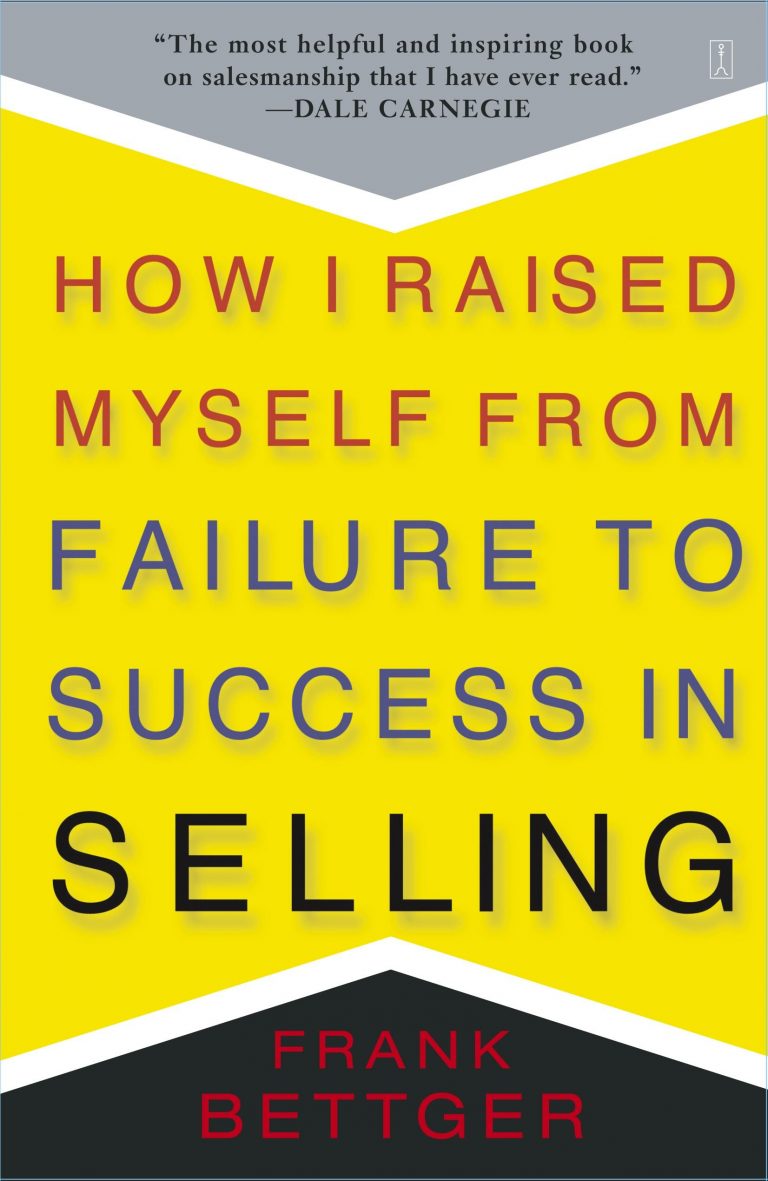
Bettger: How I Raised Myself from Failure to Success in Selling

About the book

This book was first published in 1947. The reading experience is like von Clausewitzs ”On War”. The similarity with the two books comes from the pioneering spirit. The books are novel and universal at the same time. Those are also like a wayback machines. You can sense things that have changed forever. For example the timeless way of doing business between people from the days of Bettger. Or the manners that people endorsed those days.

Bettger’s book is like a handbook of a salesmen. Or let’s say THE handbook of a salesman. Most of his findings are still here. Maybe today many of his insights are already common understanding, but most probably this was not the case in 1947 or at least not widely known.

How was the book?

I enjoyed reading this Bettgers book, because he believed in the power of enthusiasm. He used his will of power to change conditions and was enthusiastic about selling. According to him the biggest factor of success in sales is being enthusiastic about selling.

Secondly he started to deploy a sales funnel ideology and metrics in his daily operations. The method was simple. He calculated how many sales calls he made, how many of those turned into a meeting and into a closed deal and most importantly what was the actual revenue.

Thirdly Bettger also analyze what is the odds of getting a deal between first and third sales call. By the way his statistics showed that the first and second sales call contributed 93 % of all the deals. Of course sales is art of being enthusiastic, but when you combine it with metrics and analysis – boom! – money keeps litterally pouring in.

He even wrote a kind of poem about making deals. We could call it the Sales Call Poem:

You can’t collect your commission until you make the sale;

You can’t make the sale ’til you write the order;

You can’t write the order ’til you have an interview (sales meeting);

And you can’t have an interview ’til you make the call!

Last, but not least. He also had an ”self-organization day” every Friday morning. It meant that he planned and booked his sales calls with his clients for the coming week or weeks. That way he used to worry about next week’s meetings only once a week.  

What are the key learnings?

11 basic principles in making that sales:

·        Make appointments

·        Be prepared

·        What is the key issue

·        Key Word Notes

·        Ask questions

·        Explode dynamite!

·        Arouse fear

·        Create confidence

·        Express honest appreciation of your listener’s ability

·        Assume a close

·        Put YOU in the interview (sales meeting)

Take enough time to think and plan. The rest is all about execution. Dedicate time to plan your activities. IBM had during Bettger’s days a so called ”Weekly Work Sheet”. That was designed as a planning tool for salesmen. They used the ”Weekly Work Sheet” to fill in his future sales meetings. Bettger used it also to schedule every hour for week the in advance.

Book an hour from every morning or evening for reading and studying. That was Bettger’s ”Six-O’clock Club”. He dedicated time for development.

Bettger had also his question method. Six things you can gain by the question method – Why don’t you ask?

1) Helps you to avoid arguments

2) Helps you to avoid talking too much

3) Enables you to help the other fellow recognize what he wants

4) Helps to crystallize the other person’s thinking

5) Helps you find the most vulnerable point with which to close the sale – the key issue.

6) Gives the other person a feeling of importance

Find out what the other fellow wants and help him to get it. This is ”the most important secret of salesmanship.” The most important word in selling is ”why”. Helps you to remember the importance of being a good listener.

Last, but not least. Bettger had his six ways to win and hold the confidence of others.

1) Deserve confidence

2) Know your business and keep on knowing your business

3) Praise your competitors

4) Bring on your witnesses

5) Look your best

6) Never exaggerate

How should we change according to the book?

Four simple things:

1) A salesman cannot know too much but he can talk too much!

2) Smile when you make sales calls.

3) First sell the appointment and then sell your product.

4) Never forget a customer; never let a customer forget you!

What should I personally do?

Benjamin Franklin’s thirteen subject a la Frank Bettger (see page 186-187).

Summary

The book in six words – The most important word in selling is ”why”.