Kategoriat
Uncategorized

Hoffman: American Icon – Alan Mulally and the Fight to Save Ford Motor Company

🔵 Haluatko lukea kirjan Amerikan kuuluisimmasta käänneyhtiöstä? Tässä on tarjolla sellainen.
✅ Kirjassa on kolme tarinaa:1. Tarina miten dollarin osakkeesta tehtiin 17 dollarin osake.2. Tarina miten selkäänpuukottajista tehtiin tiimi.3. Tarina Fordin kasvukaavasta.
✅ Dollarin osakkeesta 17 dollarin osakkeeksi on seurausta kaikesta seuraavasta. 
✅ Mullally oli prosessijohtaja. Hän vakioi viikoittaiset johtoryhmäkokoukset, oli uskollinen datalle sekä piti kiinni yhdessä asioiden saavuttamisesta.
✅ Fordin kasvukaava oli ilmastomuutos + rönsyjen saneeraus + ennakointi. Mulally otti Fordilla ilmastomuutoksen liiketoiminnan ytimeen, myi ulkoimaiset brändit Aston Martinista Volvoon, saneerasi rönsyt ja lainasi p!rusti rahaa ennen vuoden 2008 lamaa.

✅ Mulallyn johtamisoppi oli pitää johtoryhmällä yhteinen unelma, noudattaa prosessia ja pitää tiimi tekemässä yhdessä töitä. Hän uskoi myös matriisiorganisaatioon, joka muuten harvoin toimii suomalaisessa organisaatiokulttuurissa.
✅ Kuusi sanaa kirjasta… If everyone is moving forward together, then success takes care of itself. —HENRY FORD

⛔️ You can’t build a reputation on what you are going to do. —HENRY FORD

Kategoriat
Uncategorized

Schmidt, Rosenberg, Eagle: Trillion Dollar Coach

About the book

Eric Schmidt et al. wrote a book about an anomaly. The book tells the story of Bill Campbell who coached in Silicon Valley. Mr. Campbell – the Trillion Dollar Coach, was coaching same time the top management from example Apple and Google.

Larry Page, Steve Jobs, Sheryl Sandberg and of course mr. Schmidt were people who he coached.  How odd? Actually it’s not odd in Silicon Valley to be coaching high-powered people who work for competing tech giants.

What made Bill Campbell so exceptional? Most probably his nature, way of working and talent of helping people to see their potential.

The stories have true value for outsiders of the Silicon Valley system. It helps us to understand the business of Silicon Valley. It can change our way of thinking. And last but least – you can learn from the stories.

Towards the end of the book the writers loses the grip from the reader. Last pages turns into testimonials from the coachees.

What are the key learnings?

Trillion Dollar Coach is about what and how Bill Campbell coached “what were the things he told people to do – and how he coached – what was his approach.”

Key learnings were:

Teams

  • “He used coaching to “mold effective people into powerful teams.
  • Everything great in the company happened in teams. That was my pitch in the talk: start treating teams, not individuals, as the fundamental building block of the organization.
  • When change happens, the priority has to be what is best for the team.”

Managers

  • Why do we need managers? “I want someone I can learn from, and someone to break ties.”

Staff meetings

  • “Pay close attention to running meetings well; “get the 1:1 right” and “get the staff meeting right” are tops on the list of his most important management principles.”

Board meetings

  • “Board meetings fail when the CEO doesn’t own and follow her agenda.
  • That agenda should always start with operational updates: the board needs to know how the company is doing.
  • That includes financial and sales reports, product status, and metrics around operational rigor (hiring, communications, marketing, support).
  • If the board has committees, for example to oversee audit and finance or compensation, have those committees meet ahead of time (in person or via phone or video conference) and present updates at the board meeting.
  • The first order of business always needs to be a frank, open, succinct discussion about how the company is performing.

Trust

  • “Perhaps the most important currency in a relationship – friendship, romantic, familial, or professional – is trust.”

Skills

  • “Many of the other skills of management can be delegated, but not coaching.”

Communications

  • Communications is critical to a company’s success. “He frequently coached us to make sure that others in the company understood what we understood.
  • Even when you have clearly communicated something, it may take a few times to sink in.
  • Repetition doesn’t spoil the prayer”

Walk

  • Bill coached walking around their Palo Alto neighborhood.

About trust:

–      Trust means loyalty.

–      Trust means integrity.

–      Trust means discretion.

–      ”Trust doesn’t mean you always agree; in fact, it makes it easier to disagree with someone.”

About stories:

–      “Don’t tell people what to do, tell them stories about why they are doing it.

–      “Bill coached me to tell stories. When people understand the story they can connect to it and figure out what to do.”

About teams. Excellent teams at Google had:

1)   Psychological safety.

2)   The teams had clear goals.

3)   Each role was meaningful.

4)   Members were reliable.

5)   Confident that the team’s mission would make a difference.

The traits of coachability are:

–      Honesty and humility.

–      The willingness to persevere and work hard.

–      A constant openness to learning.

How should we change according to the book?

We should adopt the future formula and ask how they stayed engaged in their careers. The answers should be:

BE CREATIVE.

  • “You should be in your most creative time.
  • You have wisdom of experience and freedom to apply it where you want.
  • Avoid metaphors such as you are on the “back nine.” This denigrates the impact you can have.”

DON’T BE A DILETTANTE.

  • “Don’t just do a portfolio of things.
  • Whatever you get involved with, have accountability and consequence. Drive it.”

FIND PEOPLE WHO HAVE VITALITY.

  • “Surround yourself with them; engage with them. Often they will be younger.”

APPLY YOUR GIFTS.

  • “Figure out what you are uniquely good at, what sets you apart.
  • And understand the things inside you that give you a sense of purpose.
  • Then apply them.”

DON’T WASTE TIME WORRYING ABOUT THE FUTURE.

  • “Allow serendipity to play a role.
  • Most of the turning points in life cannot be predicted or controlled.”

What should I personally do?

“A big turnoff for Bill was if they were no longer learning. Do they have more answers than questions? That’s a bad sign!”

Summary

The book in six words – “If you’ve been blessed, be a blessing.” Ron Johnson (CEO of JCPenney)

Kategoriat
Uncategorized

Gladwell: Outliers

How was the book?

Malcom Gladwell starts his book very boldly stating that ”I will argue that there is something profoundly wrong with the way we make sense of success.” And indeed he is right. I have read ”million” articles stating what to do in order to become successful.

He continues that ”their success is not exceptional or mysterious. It is grounded in a web of advantages and inheritances, some deserved, some not, some earned, some just plain lucky—but all critical to making them who they are”. So there is no secret ingredient or recipe on how to become successful. There are the 10 000 hours rules etc. but mainly we are talking about factors  

”This is not a book about tall trees. It’s a book about forests—and hockey is a good place to start because the explanation for who gets to the top of the hockey world is a lot more interesting and complicated than it looks. In fact, it’s downright peculiar. ”

”The outlier, in the end, is not an outlier at all.”

What are the key learnings of the book? 

To become successful you need:

·       Accumulative advantage,

·       you have to be skilled-talented-driven -type of person and

·       (second) chance.

Outliers are ”men and women who do things that are out of the ordinary”. And this book is about their success. ”Success is the result of what sociologists like to call “accumulative advantage.””

But there is no mystery about being a successful. The story of their success is based on:

1)  history

2)  community,

3)  opportunity and

4)  legacy.

Besides those facts the Outliers are first and foremost the skilled, the talented, and the driven.

History

History explains something about people who are extraordinary successful – they were born in the right time. For example ”more hockey players were born in January than in any other month, and by an overwhelming margin. The second most frequent birth month? February. The third? March.”

It’s because ”coaches start to select players for the traveling “rep” squad—the all-star teams—at the age of nine or ten, and of course they are more likely to view as talented the bigger and more coordinated players, who have had the benefit of critical extra months of maturity.”

The same goes with first industrial wave in the USA and it goes with the tech billionaires. They were born in the right time.

Community

Community matters. Gladwell uses a village called Roseto as an example.

It is a village in hills of eastern Pennsylvania. They had ”created a powerful, protective social structure capable of insulating them from the pressures of the modern world.” People living in Roseto were protected, because they lived in that particular village.

Opportunity

Gladwell uses Beatles and Bill Gates as an examples when illustrating the meaning of opportunity on becoming successful.

Beatles: “They were no good onstage when they went there and they were very good when they came back,” Norman went on. “They learned not only stamina. They had to learn an enormous amount of numbers—cover versions of everything you can think of, not just rock and roll, a bit of jazz too. They weren’t disciplined onstage at all before that. But when they came back, they sounded like no one else. It was the making of them.”

Bill Gates: “It was my obsession,” Gates says of his early high school years. “I skipped athletics. I went up there at night. We were programming on weekends. It would be a rare week that we wouldn’t get twenty or thirty hours in. There was a period where Paul Allen and I got in trouble for stealing a bunch of passwords and crashing the system.”

”All the outliers we’ve looked at so far were the beneficiaries of some kind of unusual opportunity. Lucky breaks don’t seem like the exception with software billionaires and rock bands and star athletes. They seem like the rule.”

Psychologist K. Anders Ericsson: ”Ten thousand hours is the magic number of greatness.” Both Beatles and Bill Gates had their obsession and they got the opportunity to practice their obsession on becoming so good that now one could compete with them. Outliers work much, much harder……

How should we change according to the book?

”Everything we have learned in Outliers says that success follows a predictable course. It is not the brightest who succeed. If it were, Chris Langan would be up there with Einstein. Nor is success simply the sum of the decisions and efforts we make on our own behalf. It is, rather, a gift. Outliers are those who have been given opportunities—and who have had the strength and presence of mind to seize them.”

1) We prematurely write off people (as failures) must be ended.

“We do ability grouping early on in childhood. We have advanced reading groups and advanced math groups. So, early on, if we look at young kids, in kindergarten and first grade, the teachers are confusing maturity with ability.

2) (Second) chance

”When the Korean pilots where given a second chance the prevailed…. And what Korean Air did, when it finally turned its operations around, was give its pilots the opportunity to escape the constraints of their cultural legacy….. We took them out of their culture and re-normed them.”

3) Society for all

”To build a better world we need to replace the patchwork of lucky breaks and arbitrary advantages that today determine success—the fortunate birth dates and the happy accidents of history—with a society that provides opportunities for all.”

Words of wisdom…. Chance society…. You just need a chance.

What should I personally do? 

I should cultivate:

·       autonomy,

·       complexity and

·       a connection between effort and reward in doing creative work

”That’s worth more to most of us than money.”

Summary

The book in six words – ”Hard work is a prison sentence only if it does not have meaning”.

Kategoriat
Uncategorized

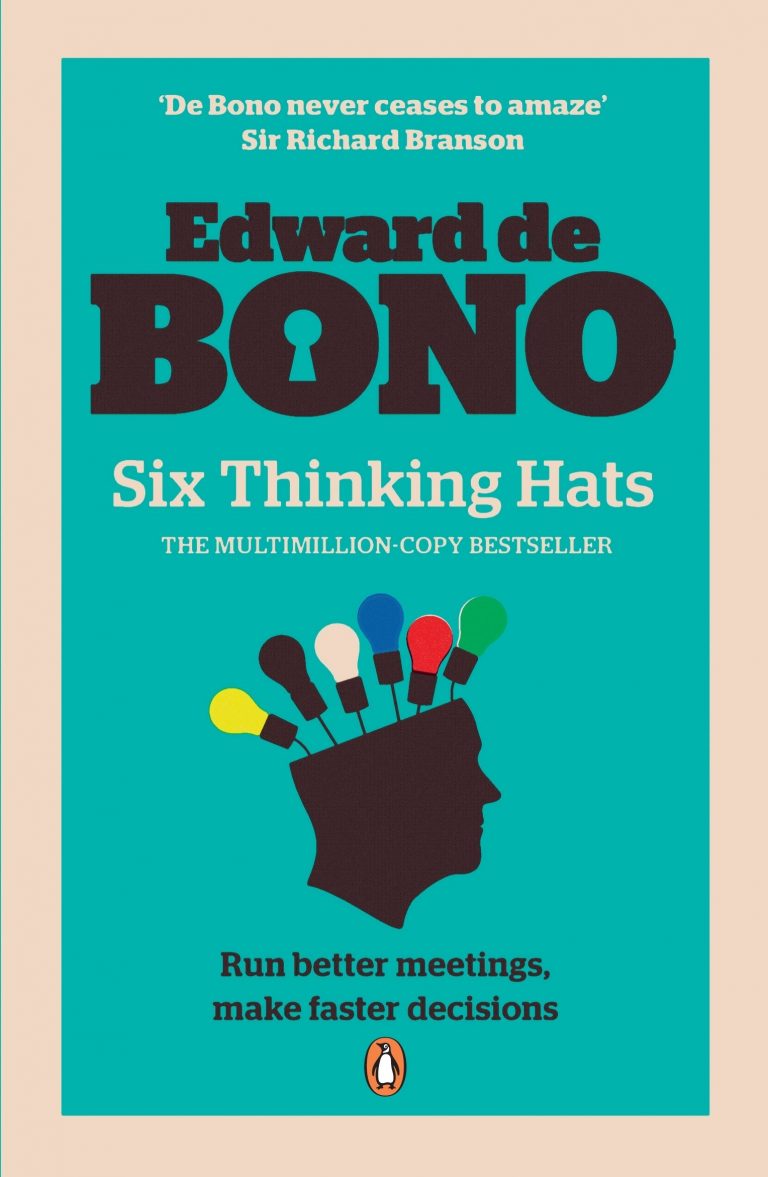
Edward de Bono: Six Thinking Hats

About the book

This book is really quick to read. It has less than 180 pages, fairly light text and lots of examples. You can read it in no time.

How was the book?

Six hat thinking is a concept where the thinker is allowed to do only one thing at a time – and that is called simplify. In this thinking technique for example the feelings is separated from logic. And information from creativity. It also gives people possibility to dive into modes that are not typical for them. Hats are directions of thinking. Participants are supposed to look or think in all possible directions. And it is essential that people will move freely between different hats or modes – from emotional to creative. Showing off is also essential. By showing that you are competent thinker. Not better than other, but better and more competent thinker by wearing all hats.

The hats are:

·       Blue Hat is about the process of thinking. Wear it to start the session and to end the session. This hat is used in that sense only by the facilitator. He indicates the target of the thinking, rules of the game, facilitates the thinking and the end-results of the thinking sessions. Blue hat gives the purpose for the session.

·       Red Hat is emotional view. It is anger, rage and emotions. No need to explain or justify the feelings. Let your emotions come out.

·       White Hat is about information, facts and figures – believed or checked (pls remember to separate those). It is neutral and objective. Share the knowledge of the topic.

·       Yellow Hat is positive opportunity thinking – looking for benefits, dreams, visions. It is all about the great and nice things. Be positive and show it with your words.

·       Black Hat is the negative and critical thinking. It is all about what could be wrong. Important hat, because it will help us survive. Give all possible reasons why this won’t work, but the criticism must be logical – make sense. Remember not to start arguing. Just point out the possible risks. Remember to document all possible problems and obstacles. You will need this as a risk assessment.

·       Green Hat is creative. Here you can invent new possibilities. Be creative, novel and escape from the old. Try to figure out how to overcome problems and obstacles. The aim is to find new ideas, approaches and alternatives. Remember – search for alternatives, the first answer is never the best.

·       Blue Hat again to wrap-up the session and show results of the thinking session. Also to start the implementation of the ideas.

Talk about the hats, refer to different colors – not about their functions. Hats can be used as single hats or in a sequence. The sequence can be evolving or pre-set. The pre-set is preferred mode if the group is novel with the technique. The blue hat facilitator will define in the beginning of the meeting the pre-set sequence. Discipline is important. Everybody must stick with his or her hats. Only the facilitator lets people to change hats. 

Blue hat is used in the beginning to define the target of the meeting. Giving reasoning to the session. And at the end to wrap-up and to make conclusions. The red hat could be used after the blue hat, because that way the feelings are dealt in the beginning of the session. Also one can re-check if the feelings have changed during the session before the last blue hat. Especially if there is knowledge that there are pre-existing feelings. Sometimes it is useful to put yellow hat before the black hat. If the yellow hat session does not bring any value to the idea, there is no idea on moving towards the black hat session. Sometimes it is useful to give people some time to think before hats are changed.

What are the key learnings?

By using this technique, you simply focus on one thing at a time. This technique can be used to whatever intellectual problem that one has. From developing new products to daily operations.

Six Hat Thinking is like gamification of thinking. People are invited to participate in game of thinking. Switching from one mode of thinking into another. This game will be quick. One thinker is typically allowed to take one minute per hat. The thinkers are advised not to respond to others ideas or remarks. You simply state your idea and the next participant will state his idea. No arguments, no nothing.

This technique allows people to be very independent thinkers. They are not tied to their roles nor anybody is expected to argue their ideas. The only expectation is that everybody shares his ideas.

How should we change according to the book?

The first answer is never the best. Seek and test other ideas. We should simplify and switch thinking. Escape from the old.

What should I personally do?

Invest time to make a test-run.

Summary

The book in six words – Confusion is the biggest enemy of good thinking.