Fisher & Ury: Getting to YES
About the book
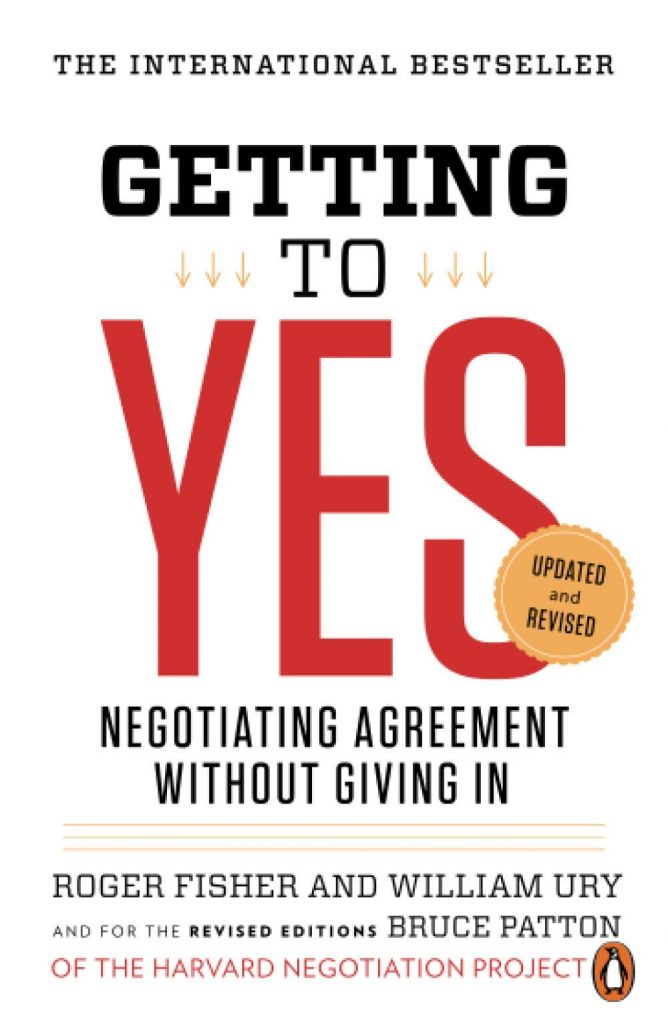
Getting to YES is a book about negotiating agreement without giving in. As Robert Fish and William Ury states in the book – negotiation is a fact of life. We are always making trade-offs, but the best part is that you get to choose what you want. It’s a back-and-forth communication designed to reach an agreement.
“Getting to YES”-method is about using independent standards to discuss the fairness of a proposal, getting to you what you deserve and protect you from getting taken.
What are the key learnings?
The key learning of the book is that the agreement is often based on disagreement and with principled negotiation you can reach a deal.
“Substantive issues need to be disentangled from relationship and process issues. The content of a possible agreement needs to be separated from questions how you talk about it and how deal with the other side. Each set of issues needs to be negotiated on its own merits:
– Substantive issues
o Terms
o Conditions
o Prices
o Dates
o Numbers liabilities
– Relationship issues
o Balance of emotions and reasons
o Ease of communications
o Degree of trust and reliability
o Attitude of acceptance (or rejection)
o Relative emphasis on persuasion (or coercion)
o Degree of mutual understanding
There is no trade-off between pursuing a good outcome and pursuing a good relationship.”
The Principled Negotiation
Before you anything – start by “envisioning what a successful agreement might look like.”
In the principled negotiation the negotiator looks for mutual gains and when interests conflict, “the negotiator should insist that the result be based on some fair standards independent of the will of either side”.
The principled negotiation method is totally apart from hard and soft methods. In soft negotiation the negotiator wants to avoid personal conflict and in hard negotiation the negotiator” sees any situation as a contest of wills”.
The “Getting to YES” or principled method has four major parts:
1) PEOPLE: Separate the people form the problem.
2) INTERESTS: Focus on interests, not positions.
3) OPTIONS: Invent options fort mutual gain.
4) CRITERIA: Insist on using objective criteria.
When evaluating the end-result – agreement, you should consider is the agreement:
· Wise agreement.
· Efficient.
· Improve relationships (or at least not damage).
People
Separate the people form the problem or “don’t bargain over positions” means that people should be attacking the problem, not each other. “Being nice is no answer” means that you are dealing with either hard or soft negotiation. When you take the soft position you loose your shirt. When you are driving a hard negotiation you are about to loose your face.
When building the people problem, you should remember three things – perception, emotion and communication:
– In perception you should put yourself into their shoes. Ask their perception or advise and give them some credit/stake in the outcome.
– In emotions pay attention to “core concerns”, make emotions legitimate and allow the other side to let off steam and use symbolic gestures (shake hands, eat together).
– In communication remember to talk to each other (acknowledge what is being said – repeat what you heard), make sure they are listening (speak to explain to be understood) and avoid misunderstanding (speak about yourself and for a purpose).
Prevention works best and by building a working relationship does help, because then you have “a foundation of trust to build upon in a difficult situation”. It helps to meet unofficially and knowing their likes and dislikes.
Interests
“A wise solution reconcile interests, not positions”. To identify interests you should ask “Why” and “Why not”. Find out their interests, because each side has multiple interests and positions. When knowing the interest you can start evaluating possible trade-offs or options to deal with. The most powerful interests are basic human needs:
– Security.
– Economic well-being.
– A sense of belonging.
– Recognition.
– Control over one’s life.
Start by documenting the interests, write a list. Then remember to explain your own interests and talk about those – in great detail, so that the other side knows your motivation behind the negotiation. Be specific, use concrete details and invite the other side to “correct me if I’m wrong”.
Options
Try to expand the pie before dividing it and do not leave money on the table. Methods how you can invent options:
1) Avoid premature judgement.
2) Do not search for a single answer.
3) The pie is not fixed.
4) Consider trying to solve their problem also.
Prescription for inventing creative options:
– Separate the act of inventing options from the act of judging them.
– Broaden the options to multiple answers.
– Search for mutual gains and weights for the gains (!!! Basis of the agreement !!!).
o Shared interests are typically latent
o Shared interests are opportunities, not godsends.
o Makes the negotiations smoother and more amicable.
– Invent ways of making their decisions easy (who’s shoes, who’s making the decision).
Types of differences are:
– Difference in interests.
– Different beliefs.
– Different values placed on time.
– Different forecasts.
– Differences in aversion to risk.
Dovetailing – “look for items that are of low cost to you and high benefit to them and vice versa”. And remember – do not leave money on the table.
Objective Criteria
Start by committing yourself reaching a solution based on principle, not pressure. The objective criteria can be fair standards (market value, scientific judgement, costs etc.), fair procedures (one cuts and the other chooses, taking turns, drawing lots, letting someone else decide):
1) Frame each issue as a joint search for objective criteria.
2) Reason and be open to reason.
3) Never yield to pressure.
BATNA
BATNA is Best Alternative To a Negotiated Agreement. It has two sides – protect yourself and make most out of it.
Negotiation Jujitsu
– Don’t attack their position, look behind it.
– Don’t defend your ideas, invite criticism and advise.
– Recast an attack on you as an attack on the problem.
– Ask questions and be silent.
Dirty Tricks
Rules for the game when the other side is using dirty tricks:
– Recognize the tactic.
– Raise the issue explicitly.
– Question the legitimacy and desirability.
Tricky Tactics
All these three might occur simultaneously:
– Deliberate deception
o Phony facts, ambiguous authority, dubious intentions, less than full disclosure.
– Psychological warfare
o Stressful situations, personal attacks, goo-guy/bad-guy routine, threats.
– Positional pressure tactics
o Refusal to negotiate, extreme demands, escalating demands, lock-in tactics, hardhearted partner, a calculated delay, “take it or leave it”
But remember not be a victim in any dirty or tricky tactics games.
Conclusion
1. You know all of this by heart.
2. Learn from doing.
3. Winning in negotiations is about way-of-working, not luring your opponent to a bad deal. It’s all about how to do well in a negotiation.
How should we change according to the book?
We should learn “how to get what we are entitled to while still getting along with the other side”.
What should I personally do?
Remember
1. BATNA.
2. Shared interests are opportunities, not godsends.
Summary
The book in six words – “Be hard on the problem, soft on the people”.